Amsterdam designer Camille Cortet created these snake-like leggings by cutting triangular apertures into the fabric.
Called Snake&Molting, the pattern changes as the wearer moves and the holes expand and contract.
This project is part of the Transformations project.
By observing animal transformations we understand animals’ behaviours that we can connect with and that we would like to have from them. These animal behaviours are inspirations for our own transformations.
The Transformations body-ornaments are about adapting animals’ behaviours to our culture. It is a way to create new gestures and new body languages within clothing and ornaments. Camille Cortet translates the animal’s beauty and finally merge with its behaviour, almost to the point of embodying it.
Snake&Molting legwear
Our skin ages through cycles of molt that we can’t notice whereas snakes have to go through exhausting stages in order to escape from their skin that becomes too old and too tigh. This behaviour and experience are translated in a body ornament.
The tights are becoming a second skin, made of a laser cut textile, they become textured with the shape of the body. The second skins evolves with our movements. It ages and breaks as a skin after several uses.
Showing posts with label FASHION. Show all posts
Tuesday, December 7, 2010
CAMILLE CORTET
Saturday, November 20, 2010
LIANNA SHEPPARD
Lianna Sheppard
MODU_GRAM
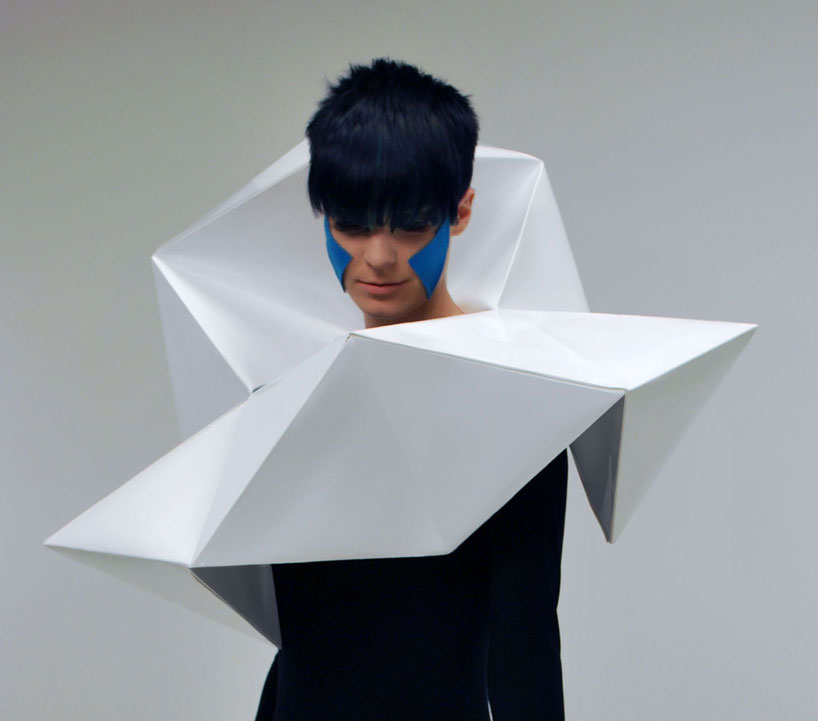
"modu_gram is a project by recent masters in fashion design graduate lianna sheppard which is
influenced by mathematical models and fractional forms. together it is a collection of wearable structures
that explore the interrelation and interplay between 3D structural shapes and forms with the
central body, creating a set of new silhouettes and encounters of human interaction and engagement."
influenced by mathematical models and fractional forms. together it is a collection of wearable structures
that explore the interrelation and interplay between 3D structural shapes and forms with the
central body, creating a set of new silhouettes and encounters of human interaction and engagement."
"The pieces transform through the use of several different mean: light movement, structure and color.
they are constructed with built-in magnets, allowing pieces to be worn at different positions on the body,
performing and transforming as a continuous series of itself. initially created through simple folds and origami techniques, forms are generated on varying scales for each structure: 'octa', 'tetra', 'edra' and 'poly'."
they are constructed with built-in magnets, allowing pieces to be worn at different positions on the body,
performing and transforming as a continuous series of itself. initially created through simple folds and origami techniques, forms are generated on varying scales for each structure: 'octa', 'tetra', 'edra' and 'poly'."
images by designboom
Friday, November 19, 2010
ANGELA ELLSWORTH
Angela Ellsworth
seer bonnets - a continuing offense
“Angela ellsworth is an american multidisciplinary artist whose paintings, drawings, installations
and performances explore the female body in its various contexts and constraints.
her work considers subjects such as physical tness, endurance, social ritual, religious tradition,
performance art and american colonial history. ellsworth's 'seer bonnets: a continuing o ense'
(2009-2010) refers to her rejected mormon heritage presented through series of antiquated
pioneer women's bonnets, constructed out of thousands of pearl-tipped corsage pins embedded
into fabric with their points directed inwards. the small, fetish-like objects not only refer to the
tradition of craft work in the home - women's work - but also stand as disembodied memorials
to the lives su ering cruelty, submission and control.”
and performances explore the female body in its various contexts and constraints.
her work considers subjects such as physical tness, endurance, social ritual, religious tradition,
performance art and american colonial history. ellsworth's 'seer bonnets: a continuing o ense'
(2009-2010) refers to her rejected mormon heritage presented through series of antiquated
pioneer women's bonnets, constructed out of thousands of pearl-tipped corsage pins embedded
into fabric with their points directed inwards. the small, fetish-like objects not only refer to the
tradition of craft work in the home - women's work - but also stand as disembodied memorials
to the lives su ering cruelty, submission and control.”
A seer bonnet
Detail of the corsage pins
Full view of a seer bonnet
Installation view
-images by designboom-
Subscribe to:
Comments (Atom)